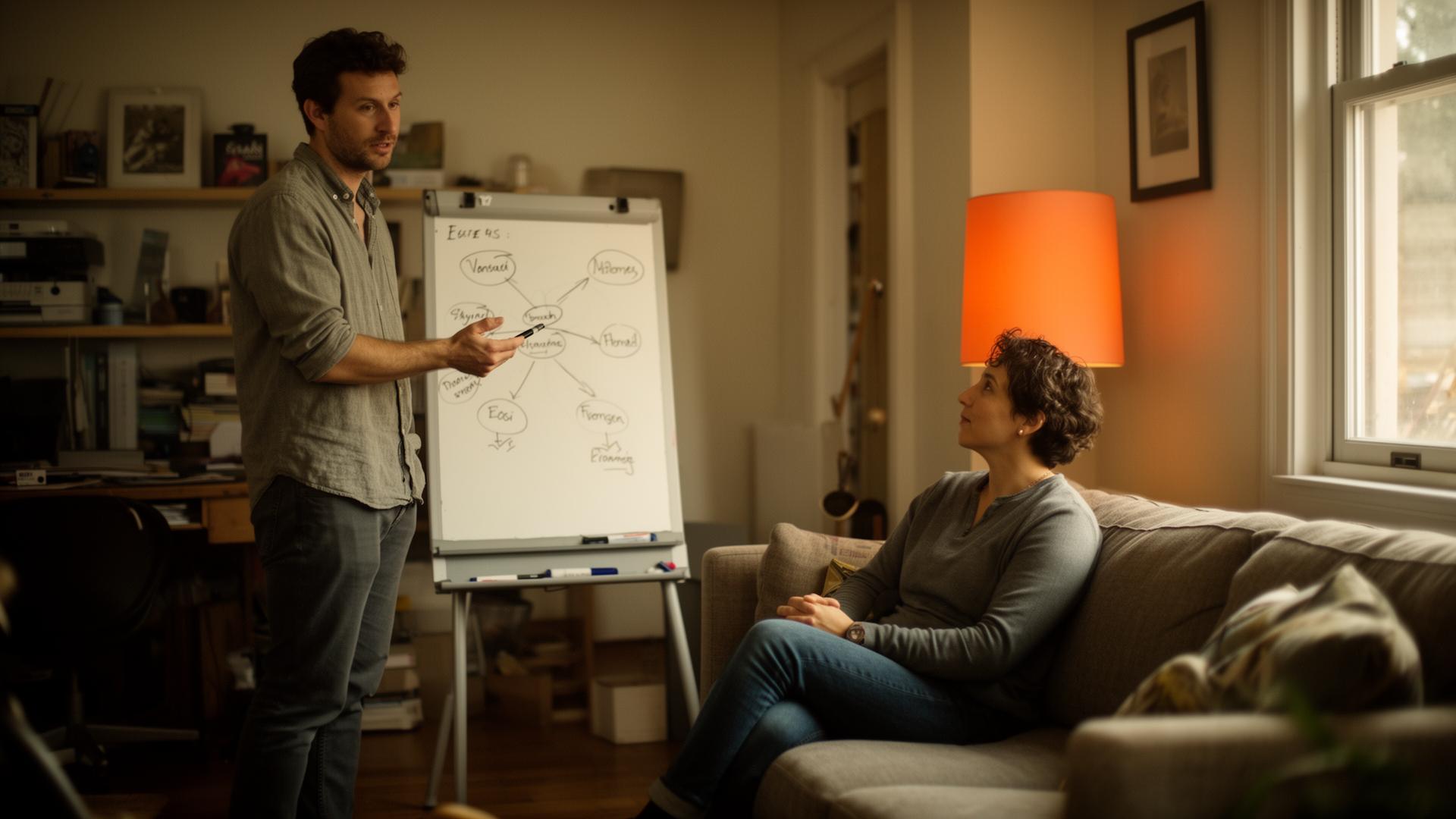
There's a teacher's joke, repeated by enough teachers that it's basically folklore: *'I didn't really understand it until I had to teach it.'*
Turns out that's not just a feeling. The cognitive science is settled. Preparing to teach something — and actually teaching it — produces deeper learning than studying for yourself. This is the protégé effect, and once you understand how it works, it changes how you approach every new skill.
This is a guide to what learning by teaching actually means, why it works, and how to use it even if you don't have a student.
What 'learning by teaching' actually means
Learning by teaching is exactly what it sounds like: you teach material to another person (or to yourself, simulating one) as a method of understanding it. The act of teaching — articulating concepts, anticipating questions, giving examples, fielding corrections — produces dramatically deeper encoding than studying alone.
It's not a metaphor. It's a measurable cognitive effect, well-documented in psychology and education research since at least the 1970s.
The mechanism breaks down into a few specific things your brain has to do when you know you'll be teaching:
- Compress. You can't teach a 50-page textbook chapter as 50 pages. You have to find the load-bearing concepts and trim everything else.
- Sequence. Teaching requires an order. What does someone need to know first? What depends on what? Building that mental order is itself a learning task.
- Anticipate. A teacher imagines what the student won't get. This forces you to find your own gaps.
- Articulate. Saying something out loud (or writing it for someone else) is harder than feeling like you understand it. The articulation gap is where most 'I get it' turns into 'actually I don't.'
All four of these are active cognitive work. None of them happen when you just re-read or watch a video.
The science: the protégé effect
The protégé effect is the formal name researchers gave the phenomenon. The clearest experiments work like this:
Two groups of students are given the same material to study, with the same time limit. Group A is told they'll be tested on it. Group B is told they'll have to teach it to another student afterward.
Both groups do their solo studying. Then the test happens. (In some versions, Group B is told the teaching part was canceled, so they only studied — they never actually teach.)
Result: Group B scores meaningfully higher than Group A. Across multiple replications, the effect is consistent — the *expectation* of teaching changes how you study, and that changed approach produces better outcomes.
When Group B *actually* teaches the material, the effect is even larger. The act of explaining locks in concepts that solo study never engaged.
This is why TA programs at universities work as a learning device for the TAs themselves. Why Feynman's technique ('explain it like I'm five') works. Why peer-led tutoring groups outperform teacher-led ones for certain learning goals. The teacher always learns more than the student.
Why teaching beats studying
A few specific differences:
Studying often feels productive when it isn't. You can re-read a chapter and feel like you've 'covered it.' You can highlight liberally and feel like you've engaged with it. Both are illusions. Teaching has no equivalent — you either can articulate the concept or you can't, and the failure is immediate.
Teaching forces retrieval. To teach something, you have to pull it out of your head, often without the source material in front of you. Active retrieval is the single most studied learning technique in cognitive science.
Teaching surfaces your own gaps fast. When a student asks 'but why is that?' and you don't know — that's the gap. You can't avoid it because the social context demands an answer.
Teaching uses the spacing effect. Most teaching involves multiple sessions, each separated by time. The spacing reinforces memory in ways that one long study marathon doesn't.
The Feynman technique (and how to do it solo)
Richard Feynman, the physicist, popularized a simple version of learning by teaching that works without a real student. The four steps:
1. Pick a concept you want to understand.
2. Try to explain it as if you were teaching a 12-year-old. Out loud, on paper, or to a recording.
3. Identify your gaps. Where did you get stuck? Where did the words become vague? Where did you fall back on jargon to avoid actually explaining?
4. Go back to the source material. Re-learn the gaps. Repeat the explanation.
Most people who try this for the first time are surprised at how quickly the gaps surface. You think you understand 'supply and demand' or 'recursion' or 'the gerund tense' — until you try to explain it without any jargon to a hypothetical kid, and discover you've been hand-waving for years.
The Feynman technique is the cheap, scalable version of learning by teaching. You don't need a student. You just need to take the explanation seriously.
5 practical ways to use learning by teaching
1. Teach a real peer (the highest-impact version)
Find someone learning in a related area and trade explanations. You teach what you've learned this week; they teach what they've learned. The presence of a real human triggers the strongest version of the effect.
This is what skill-swap networks are built for. Networks like TRADDE make this systematic by matching skill traders.
2. Run a 'teach yourself' notebook
Maintain a notebook where every chapter you read or video you watch ends with you writing the teaching version. Not summary notes — *teaching* notes. Imagine a student reading these; would they understand?
Pro tip: write the explanation BEFORE looking at any source material. Then check what you missed.
3. Record voice memos explaining concepts
After a study session, record a 90-second voice memo 'teaching' what you just learned, talking out loud. Play it back later. The act of articulating verbally engages different brain areas than writing.
4. Write a public blog post or thread
Publishing a written explanation of something you're learning is the strongest commitment device. The implicit 'students' are real readers. The pressure to not embarrass yourself is real motivation.
5. Run a study group where you take turns teaching
If you're studying a structured topic with others, formalize a rotation: each session, one person teaches the chapter or topic. Everyone studies, but the teaching role rotates. The teacher always learns most that day.
When this method works best
Learning by teaching is most powerful for:
- Conceptual material where understanding the *why* matters
- Material with hidden gaps that solo study tends to skip
- Long-term retention rather than crammed-for-an-exam knowledge
It's less effective for:
- Pure motor skills (sports, instruments, drawing) where teaching doesn't substitute for reps
- Pure recall (vocabulary, dates, formulas) where spaced repetition is more efficient
- Tacit knowledge that's hard to articulate at all (taste, judgment, accent)
For everything in the middle — most adult learning goals — learning by teaching is in the top three most effective methods.
How learning by teaching compares to other methods
| Method | Effectiveness | Effort | Best for |
| --- | --- | --- | --- |
| Re-reading | Very low | Low | Almost nothing |
| Highlighting | Very low | Low | Looking productive |
| Watching video | Low | Low | Introduction only |
| Solo studying with retrieval | Medium-high | Medium | Most material |
| Spaced repetition | High | Medium | Vocabulary, facts |
| Active practice / problem solving | High | High | Skills, math, code |
| Learning by teaching | Highest | High | Conceptual depth |
The 'highest effectiveness' rating isn't theoretical. Learning by teaching consistently outperforms even strong methods like spaced repetition for conceptual material.
Frequently asked questions
Is the protégé effect a real thing?
Yes, well-documented across multiple studies since the 1970s. Students who prepare to teach material learn it better than students who prepare for a test, and students who actually teach learn even more than that.
Do I need a real student?
No. The Feynman technique (teaching to a hypothetical 12-year-old, out loud or in writing) captures most of the benefit. But teaching a real human captures more.
Is this the same as the Feynman technique?
Feynman's technique is one specific method of learning by teaching — solo, written or spoken, explaining to an imagined non-expert. Learning by teaching is the broader category.
Can I teach beginners if I'm not an expert?
Yes — and you're often a better teacher of beginners than an expert is. Experts have the 'curse of knowledge' — they've forgotten what was confusing because their knowledge is too automatic.
Does this work for languages?
Yes. Teaching grammar concepts to a beginner — even if you're only intermediate yourself — locks them into your brain in ways no amount of solo drilling does.
How long until I see the effect?
Within a single study session. The first time you try the Feynman technique on a topic you thought you understood, you'll find a gap within five minutes.
What to do today
Pick something you're trying to learn. Right now, before you do anything else:
1. Open a blank document or voice memo
2. Try to explain that concept as if to a 12-year-old, without any jargon
3. Notice exactly where you get stuck or wave hands
4. Go back to the source material on those specific gaps
5. Rewrite the explanation
Total time: 15-30 minutes. Total cost: zero. Effect on retention: dramatic.
If you have a learning partner, do this exercise out loud with them. If you don't have a learning partner, find one — networks like TRADDE exist specifically to pair learners who can teach each other.
The teacher always learns more than the student. Once you internalize that, you stop seeing teaching as something you do *after* learning, and start seeing it as how you learn in the first place.
---
*TRADDE is a peer learning network where members teach what they know in exchange for what they want to learn — built around the protégé effect. Browse skills or start your profile — no subscription, no fees.*